About Us
Students of the text. Responsible for the Prastuti.
Sacred Threads is a continuing practice of staying with Ram Katha - studying, listening, questioning and making our encounters with the text available through words, music, images, video and this website.

What is our Role and Responsibility?
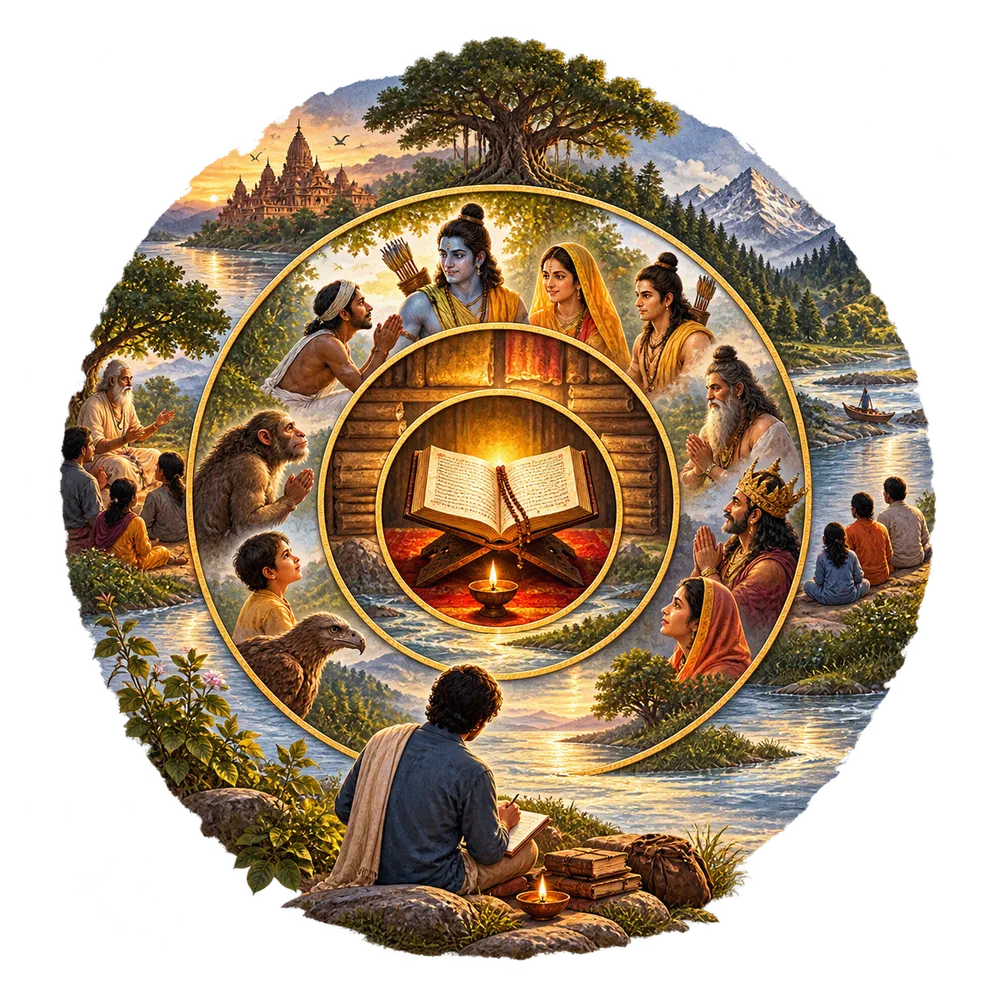
Our role begins with being present before the text. Across our work, we have usually begun not with something we wanted the text to prove, but with something that made us stop - a question, an affection, a discomfort, a curiosity, or simply an encounter worth staying with.
We try to stay with the text long enough to hear what it permits us to hear. That is different from arriving primarily to explain it.
But listening does not make us passive transmitters. We choose what to stay with, what questions to ask, which passages to include, where to begin and end, how to translate, and how to use words, music, images and silence. We make a Prastuti from our encounter with the text, and those choices create responsibility.
That responsibility moves in three directions.
Towards the text: We try not to make it carry our convenience, categories or conclusions. Our responsibility is not merely to preserve its words, but to remain attentive to the ways our questions and presentation can make it say more - or less - than it does.
Towards those who encounter the text through us: We are responsible for what we place between the visitor and the text - selection, translation, context, imagery, music and our own words. We try to make our choices visible without prescribing how someone else must encounter Ram Katha.
Towards our own work: When a question, selection, presentation or understanding is ours, we take responsibility for it. Restraint does not require us to pretend that we have understood nothing; it requires us not to make the text responsible for what is ours.
We are therefore neither outside the Katha explaining it nor claiming to speak on its behalf. We stay with it, study it, listen to it, ask questions of it, and make a Prastuti from that encounter.
Why are we students?
Studenthood, for us, is not a disclaimer about qualifications, nor a claim to humility. It describes the relationship we choose to maintain with the texts we study.
We choose to remain students because it keeps the text above us. Familiarity with a text does not place our frameworks, categories or conclusions above it. When something challenges what we thought we understood, our understanding remains available for reconsideration.
Studenthood also helps us keep enquiry open. Accumulated study can become accumulated certainty, until every new encounter begins confirming what we already believe. A passage, conversation or even a single verse should remain capable of making us enquire again.
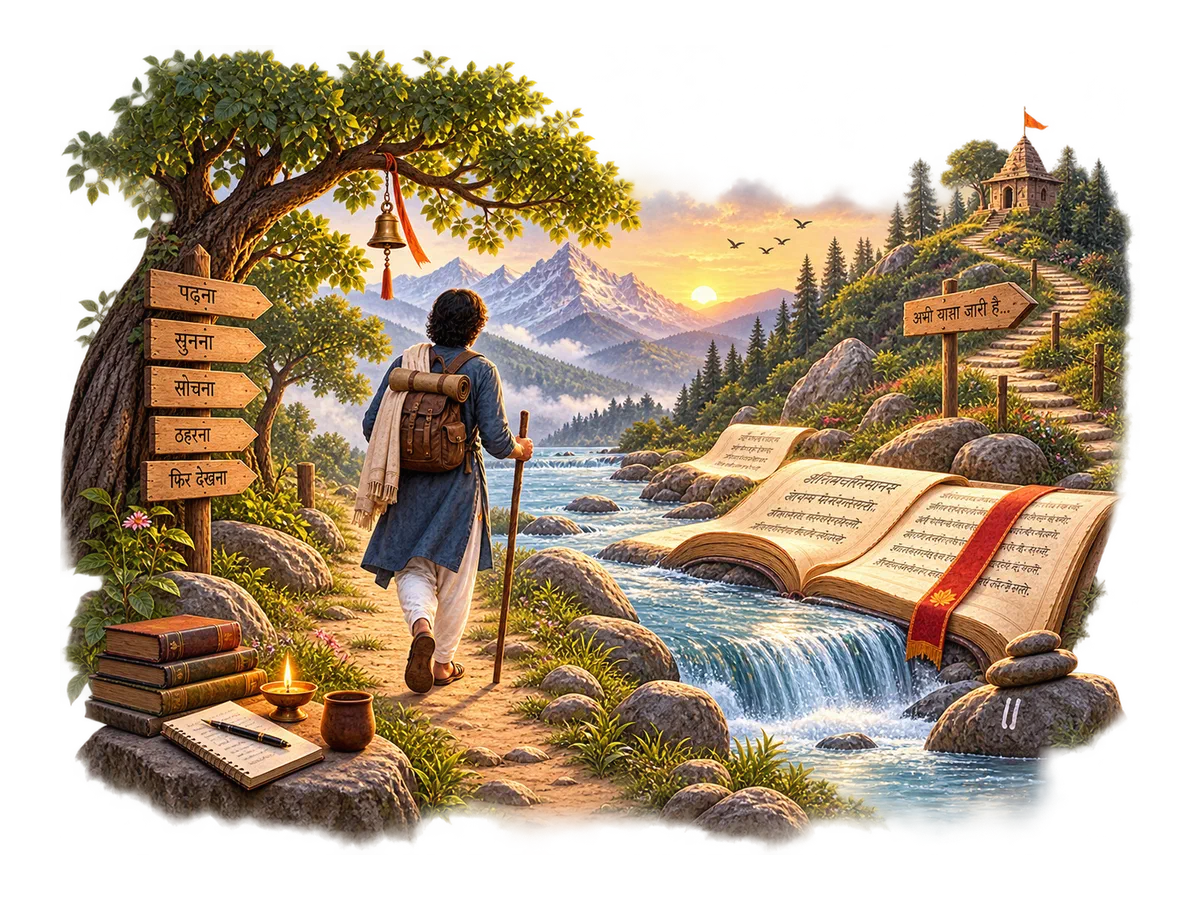
We therefore try to walk alongside the text rather than claim its width or depth. We can speak about where we have walked, what we encountered there, the questions that arose and what we presently understand. We do not claim that the portions we have studied give us authority over the whole.
Most importantly, studenthood asks us to respect the authors and their work. We can study their words, structures, narrative choices, contexts and relationships closely. But the exact thinking of Maharishi Valmiki, Goswami Tulsidas or another author is not directly available to us.
Being students does not require us to avoid understanding or conclusions. It asks us to remain clear about where they come from.
The text may permit an understanding; the understanding may become ours; that does not make it the author’s stated understanding.
What sources are we using?
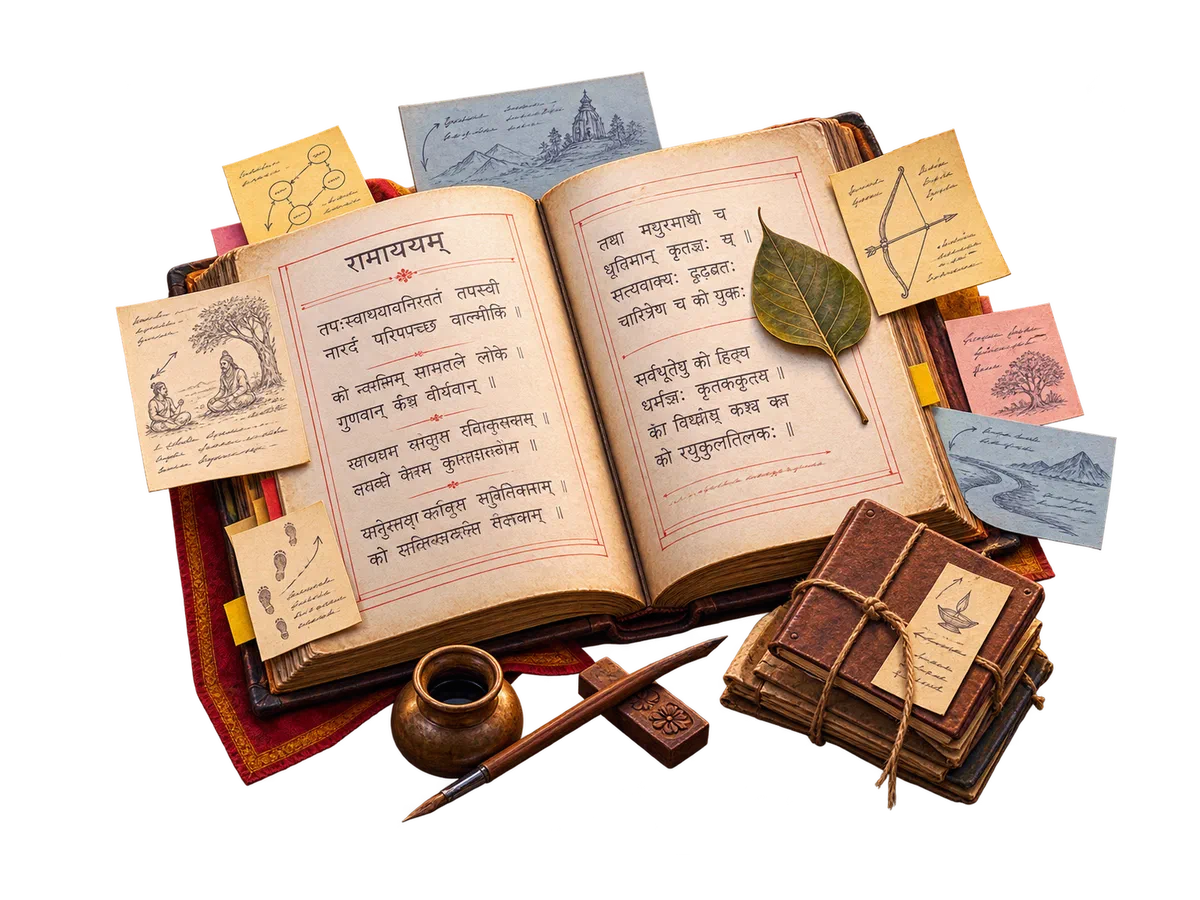
The primary texts that have grounded Sacred Threads so far are:
- Shrimad Valmiki Ramayana
- Shri Ramcharitmanas
Different series have stayed with different texts. Sab ke Ram, Sab ki Sita, Maryadit Ram, Manglacharan, Manas Vandana and much of Bacchon ke Ram have emerged from Shri Ramcharitmanas, while Yuddha ke Drishtikon has involved sustained study of the Shrimad Valmiki Ramayana.
These are the primary texts with which we have worked so far, not a declaration that our future study must remain restricted to them.
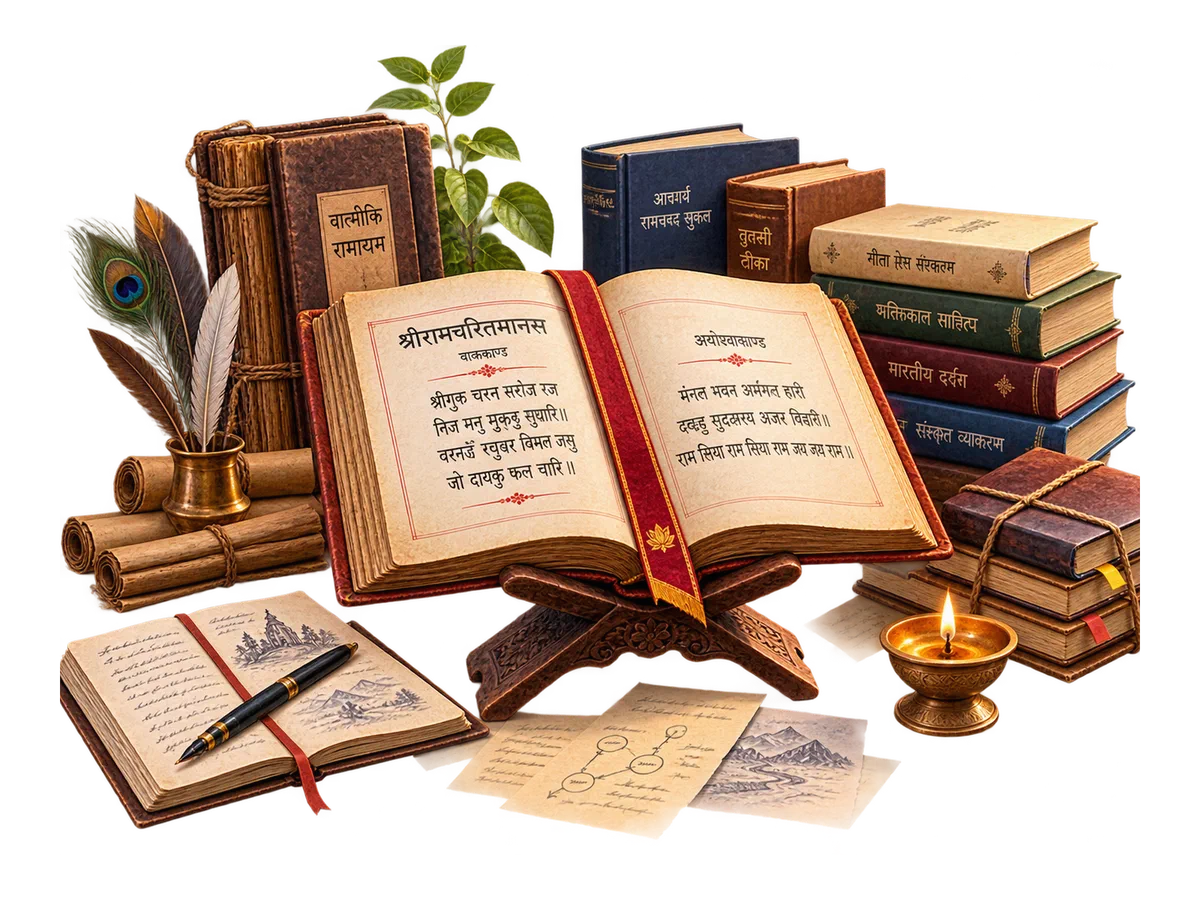
We try to encounter the primary text directly and remain anchored in it. Depending on the enquiry, translations, dictionaries, commentaries, grammatical and textual references, traditional understandings, scholarly work and contextual material may assist us in reading more carefully.
A supporting source can help us read the text; it should not quietly replace the text. When an understanding comes specifically from another source, we try to identify it accordingly.
Our earlier encounters with Ram Katha inevitably accompany later ones too. They form part of our developing understanding, but do not acquire the status of the primary text. We remain conscious that yesterday’s understanding can become tomorrow’s lens - and that the next encounter may ask us to look again.
What is our claim of ownership without authorship?
We make no claim of authorship over Ram Katha or the texts with which we work. Their verses, narratives, characters, conversations and events precede us. Selecting, translating, arranging or presenting them does not make them ours.
But the Prastuti is ours.
We choose the encounter, ask the questions, select passages, decide where to begin and stop, translate and arrange, and make choices about recitation, music, silence, pacing, imagery and sequencing. The series and frameworks through which we organize these encounters are also ours.
Our claim of ownership is therefore principally a claim of responsibility, not authority.
When we say something is ours, we mean:
We are answerable for this.
If an image overstates something, a translation introduces an unsupported nuance, or a framework makes the text carry more than it does, those choices are ours to examine. We cannot transfer responsibility for them to Maharishi Valmiki, Goswami Tulsidas or the text itself.
Similarly, an understanding emerging from our study may become our understanding without becoming a claim about exactly what the author intended.
A simple distinction guides us:
Where the text speaks, we try to remain answerable to it. Where the text does not speak, we remain responsible for the choices we make.
And there is something we cannot own: the visitor’s encounter. We can take responsibility for what we place before someone; what they notice, question, understand or carry away from Ram Katha belongs to them.
What boundaries do we have when studying, writing and producing?
Our freedom to study, question and present is substantial, but it is not unlimited. The text creates the first boundary.
We can ask difficult questions, stay with uncomfortable passages, develop frameworks and arrive at understandings. But we cannot require the text to support them. If a contemporary lens, an established framework or one of our own earlier understandings does not sit comfortably with what is before us, the text does not have to accommodate us.
Some boundaries follow from this:
We distinguish the text from our understanding, and our understanding from claims about an author’s intention.
Our frameworks remain subordinate to the encounter. A framework may help us walk with the text; it cannot demand that the text walk within it.
Accessibility does not justify simplification. Translation, music, visuals, context and technology can lower barriers to entry without converting complexity into a simpler moral, removing discomfort or manufacturing resolution. We try to lower the threshold without lowering the text.
Reverence does not permit us to improve the text. Idealisation, softening an uncomfortable action, or explaining away a difficult exchange can overwrite a passage just as readily as a contemporary interpretation can.
Production remains answerable to the text. Music creates emotion; images create characterization; editing creates emphasis; titles create expectations. Creative effectiveness does not by itself justify what these choices add.
We do not prescribe the visitor’s relationship with Ram Katha. We can make our way of listening visible; we do not claim that it is the only or right way to encounter the text.
These boundaries are not frozen. Some have become visible only through the work itself; others may become more precise, and new ones may emerge.
Our boundaries can evolve without our commitment to boundaries becoming negotiable.
What is our typical manner of working, approach and methodology?
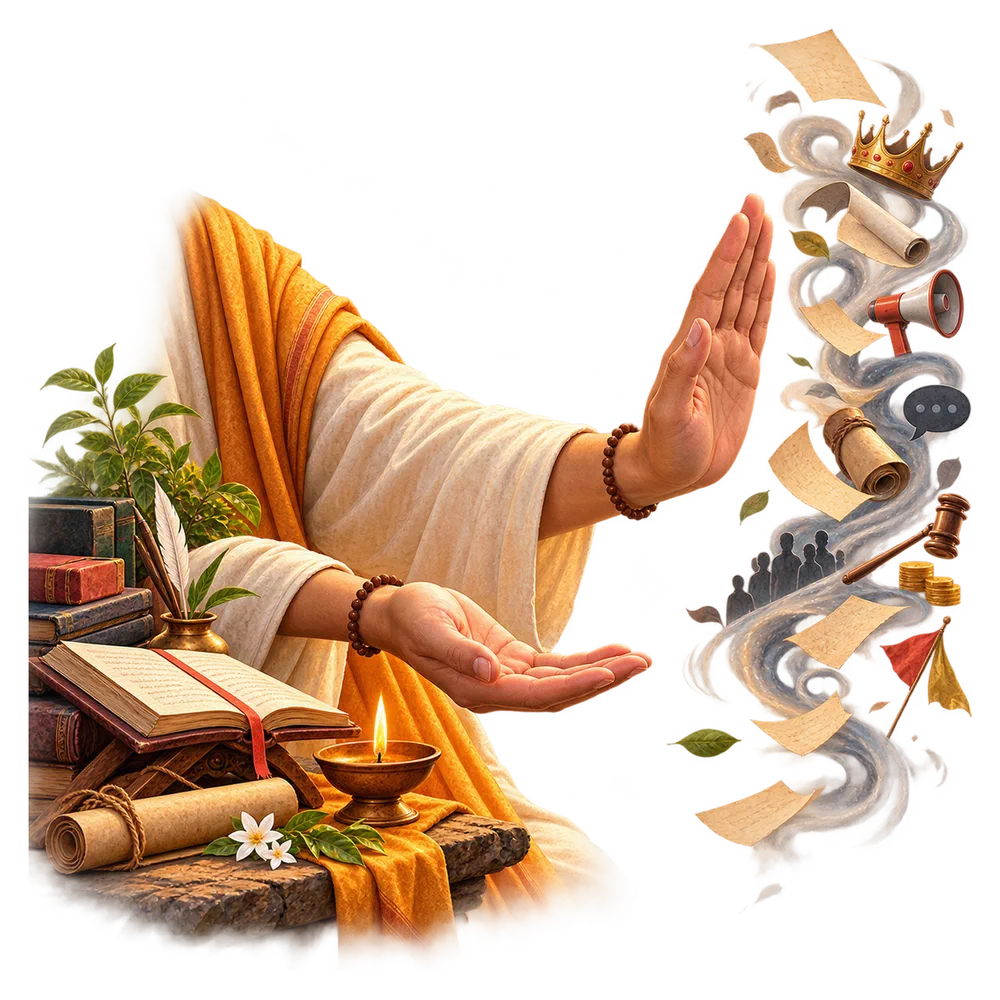
We usually begin with the text rather than with a message we want the text to deliver.
When a passage, conversation, event or verse stops us, we stay with it and read around it - what comes before and after, who speaks, to whom, under what circumstances, and whether something elsewhere in the text changes how the moment may be encountered.
Questions are central to this process, but the first question does not automatically survive. We return to the text, test the question itself and allow it to change. Sometimes we find an answer; sometimes another question emerges; sometimes something simply remains unresolved.
Other sources and tools may help us search, compare, translate, question and test. Throughout, we try to remain conscious of the distinction between what comes from the primary text, what comes from another source, and what is our own understanding.
Our process is iterative rather than strictly linear. Study informs translation and production, but translation, music, visuals and editing can expose questions that send us back to the text:
study → understand → present → notice → return → reconsider → present again
Selection and restraint are therefore part of the work. We ask not only what to include, but what our choices add, remove or imply. Sometimes responsibility means doing less; sometimes it requires additional verses, context or explanation.
Nor do we require every study to produce a conclusion. A question can remain open, two things can remain in tension, and an encounter can remain unfinished even when the Prastuti itself is complete.
What we learn accumulates, but remains revisable. The next encounter retains the possibility of complicating what we thought we had already understood.
What finally emerges is therefore our Prastuti of an encounter with the text - not a claim to have exhausted that encounter.

What is our Role and Responsibility?
Our role begins with being present before the text. Across our work, we have usually begun not with something we wanted the text to prove, but with something that made us stop - a question, an affection, a discomfort, a curiosity, or simply an encounter worth staying with.
We try to stay with the text long enough to hear what it permits us to hear. That is different from arriving primarily to explain it.
But listening does not make us passive transmitters. We choose what to stay with, what questions to ask, which passages to include, where to begin and end, how to translate, and how to use words, music, images and silence. We make a Prastuti from our encounter with the text, and those choices create responsibility.
That responsibility moves in three directions.
Towards the text: We try not to make it carry our convenience, categories or conclusions. Our responsibility is not merely to preserve its words, but to remain attentive to the ways our questions and presentation can make it say more - or less - than it does.
Towards those who encounter the text through us: We are responsible for what we place between the visitor and the text - selection, translation, context, imagery, music and our own words. We try to make our choices visible without prescribing how someone else must encounter Ram Katha.
Towards our own work: When a question, selection, presentation or understanding is ours, we take responsibility for it. Restraint does not require us to pretend that we have understood nothing; it requires us not to make the text responsible for what is ours.
We are therefore neither outside the Katha explaining it nor claiming to speak on its behalf. We stay with it, study it, listen to it, ask questions of it, and make a Prastuti from that encounter.
Why are we students?
Studenthood, for us, is not a disclaimer about qualifications, nor a claim to humility. It describes the relationship we choose to maintain with the texts we study.
We choose to remain students because it keeps the text above us. Familiarity with a text does not place our frameworks, categories or conclusions above it. When something challenges what we thought we understood, our understanding remains available for reconsideration.
Studenthood also helps us keep enquiry open. Accumulated study can become accumulated certainty, until every new encounter begins confirming what we already believe. A passage, conversation or even a single verse should remain capable of making us enquire again.
We therefore try to walk alongside the text rather than claim its width or depth. We can speak about where we have walked, what we encountered there, the questions that arose and what we presently understand. We do not claim that the portions we have studied give us authority over the whole.
Most importantly, studenthood asks us to respect the authors and their work. We can study their words, structures, narrative choices, contexts and relationships closely. But the exact thinking of Maharishi Valmiki, Goswami Tulsidas or another author is not directly available to us.
Being students does not require us to avoid understanding or conclusions. It asks us to remain clear about where they come from.
The text may permit an understanding; the understanding may become ours; that does not make it the author’s stated understanding.
What sources are we using?
The primary texts that have grounded Sacred Threads so far are:
- Shrimad Valmiki Ramayana
- Shri Ramcharitmanas
Different series have stayed with different texts. Sab ke Ram, Sab ki Sita, Maryadit Ram, Manglacharan, Manas Vandana and much of Bacchon ke Ram have emerged from Shri Ramcharitmanas, while Yuddha ke Drishtikon has involved sustained study of the Shrimad Valmiki Ramayana.
These are the primary texts with which we have worked so far, not a declaration that our future study must remain restricted to them.
We try to encounter the primary text directly and remain anchored in it. Depending on the enquiry, translations, dictionaries, commentaries, grammatical and textual references, traditional understandings, scholarly work and contextual material may assist us in reading more carefully.
A supporting source can help us read the text; it should not quietly replace the text. When an understanding comes specifically from another source, we try to identify it accordingly.
Our earlier encounters with Ram Katha inevitably accompany later ones too. They form part of our developing understanding, but do not acquire the status of the primary text. We remain conscious that yesterday’s understanding can become tomorrow’s lens - and that the next encounter may ask us to look again.
What is our claim of ownership without authorship?
We make no claim of authorship over Ram Katha or the texts with which we work. Their verses, narratives, characters, conversations and events precede us. Selecting, translating, arranging or presenting them does not make them ours.
But the Prastuti is ours.
We choose the encounter, ask the questions, select passages, decide where to begin and stop, translate and arrange, and make choices about recitation, music, silence, pacing, imagery and sequencing. The series and frameworks through which we organize these encounters are also ours.
Our claim of ownership is therefore principally a claim of responsibility, not authority.
When we say something is ours, we mean:
We are answerable for this.
If an image overstates something, a translation introduces an unsupported nuance, or a framework makes the text carry more than it does, those choices are ours to examine. We cannot transfer responsibility for them to Maharishi Valmiki, Goswami Tulsidas or the text itself.
Similarly, an understanding emerging from our study may become our understanding without becoming a claim about exactly what the author intended.
A simple distinction guides us:
Where the text speaks, we try to remain answerable to it. Where the text does not speak, we remain responsible for the choices we make.
And there is something we cannot own: the visitor’s encounter. We can take responsibility for what we place before someone; what they notice, question, understand or carry away from Ram Katha belongs to them.
What boundaries do we have when studying, writing and producing?
Our freedom to study, question and present is substantial, but it is not unlimited. The text creates the first boundary.
We can ask difficult questions, stay with uncomfortable passages, develop frameworks and arrive at understandings. But we cannot require the text to support them. If a contemporary lens, an established framework or one of our own earlier understandings does not sit comfortably with what is before us, the text does not have to accommodate us.
Some boundaries follow from this:
We distinguish the text from our understanding, and our understanding from claims about an author’s intention.
Our frameworks remain subordinate to the encounter. A framework may help us walk with the text; it cannot demand that the text walk within it.
Accessibility does not justify simplification. Translation, music, visuals, context and technology can lower barriers to entry without converting complexity into a simpler moral, removing discomfort or manufacturing resolution. We try to lower the threshold without lowering the text.
Reverence does not permit us to improve the text. Idealisation, softening an uncomfortable action, or explaining away a difficult exchange can overwrite a passage just as readily as a contemporary interpretation can.
Production remains answerable to the text. Music creates emotion; images create characterization; editing creates emphasis; titles create expectations. Creative effectiveness does not by itself justify what these choices add.
We do not prescribe the visitor’s relationship with Ram Katha. We can make our way of listening visible; we do not claim that it is the only or right way to encounter the text.
These boundaries are not frozen. Some have become visible only through the work itself; others may become more precise, and new ones may emerge.
Our boundaries can evolve without our commitment to boundaries becoming negotiable.
What is our typical manner of working, approach and methodology?
We usually begin with the text rather than with a message we want the text to deliver.
When a passage, conversation, event or verse stops us, we stay with it and read around it - what comes before and after, who speaks, to whom, under what circumstances, and whether something elsewhere in the text changes how the moment may be encountered.
Questions are central to this process, but the first question does not automatically survive. We return to the text, test the question itself and allow it to change. Sometimes we find an answer; sometimes another question emerges; sometimes something simply remains unresolved.
Other sources and tools may help us search, compare, translate, question and test. Throughout, we try to remain conscious of the distinction between what comes from the primary text, what comes from another source, and what is our own understanding.
Our process is iterative rather than strictly linear. Study informs translation and production, but translation, music, visuals and editing can expose questions that send us back to the text:
study → understand → present → notice → return → reconsider → present again
Selection and restraint are therefore part of the work. We ask not only what to include, but what our choices add, remove or imply. Sometimes responsibility means doing less; sometimes it requires additional verses, context or explanation.
Nor do we require every study to produce a conclusion. A question can remain open, two things can remain in tension, and an encounter can remain unfinished even when the Prastuti itself is complete.
What we learn accumulates, but remains revisable. The next encounter retains the possibility of complicating what we thought we had already understood.
What finally emerges is therefore our Prastuti of an encounter with the text - not a claim to have exhausted that encounter.
Who is behind Sacred Threads?

Aditya Nandan Prasad
My name is Aditya Nandan Prasad.
I was born and brought up in a small township in Jharkhand, in an environment where religious practice was part of ordinary life. Bhajan, kirtan, Sufi music and religious discourses were familiar presences while growing up. Later, my encounters expanded to include different religious and philosophical traditions.
Ram Katha has been a particularly long companionship. For decades, much of that relationship was through listening - through music, recitation, discourse and other forms in which the Katha reached me. Over time, this developed into an interest in experiencing Ram Katha through different media, and eventually into the work that became Sacred Threads.
Sacred Threads gradually changed the nature of that relationship. Listening led to closer reading; reading brought questions; questions required returning to the text; and sometimes the text required setting aside the very question or understanding with which I had arrived. What began partly as an attempt to present Ram Katha through different media has therefore also become a continuing period of study and enquiry.
I do not bring a claim of academic, spiritual or interpretive authority to this work. I approach these texts as a student - trying to keep the text above my understanding, to continue enquiring and learning, and to walk alongside what I study without claiming its width or depth.
Sacred Threads uses music, words, images, video and this website to make these encounters available to others. The texts and the Katha are not mine. The questions I ask, the selections and presentations I make, and the understandings I choose to articulate are mine to take responsibility for.