Studies

Questions we carry. Texts we return to. Listenings that shape our understanding.

This is our space for deeper enquiries into Ram Katha - texts, traditions, characters, ideas and questions that invite our attention again and again.

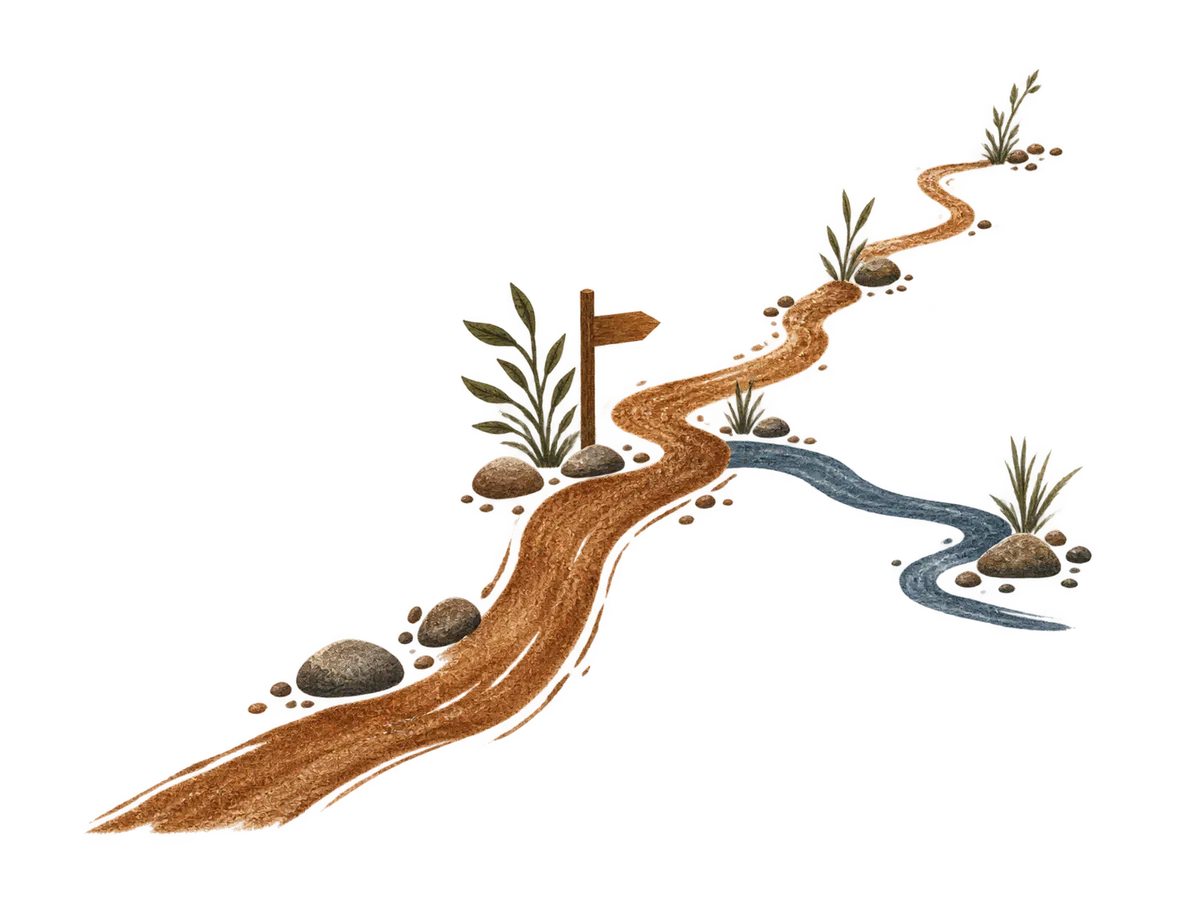
An illustrated riverside path branching beside a signpost marked A Text, A Question, A Closer Look and An Open Path.

Understanding this space

Three aspects of how we stay with the text.

Why additional context, branched work and our understandings matter?

As we stay with the text, certain details, words, characters or moments open into larger questions. These branches help us see the text more fully, sit with its complexity, and remain open to new possibilities. They keep our listening alive.

Read further

Why our understanding can change?

We do not expect the text to change. We expect our questions, attention and understanding to remain capable of change as we continue to stay with it. A study may deepen, complicate or even leave us without a conclusion. That too is our present understanding.

Read further

This is not a repository of articles and blogs

Our work does not begin with a need to publish something. It begins with something we have noticed in the text and decided to pursue. These pages are working records of our enquiries - not polished arguments, not final answers, and not a collection of articles.

Read further

Why additional context, branched work and our understandings matter?

Our work with Ram Katha does not always remain within the boundaries in which it began. While studying a passage, preparing an episode, working through a series, or simply returning to the text, we may notice something that asks us to look further. A small textual detail may raise a larger question. Something encountered in one place may acquire significance when encountered elsewhere. A question about an event may lead us towards particular characters, relationships, choices, words or passages that the original work was never intended to examine.

When we notice such a branch and believe that it deserves further attention, we may decide to pursue it.

The commitment then is to the pursuit, not to an outcome.

We do not begin with the expectation that every question must produce an answer, every observation must become a pattern, or every study must lead to a conclusion. Pursuing a branch may deepen our understanding. It may complicate an earlier understanding. It may reveal several possibilities without allowing us to choose between them. The question itself may change as we study. Something that initially appeared significant may not be sustained when we look more widely. And sometimes, after following a question as far as we presently can, we may find that we cannot responsibly say much more.

That too is an outcome.

More importantly, that too is our understanding.

This is why these enquiries need a space beyond the work from which they arose. An episode need not become longer because it gave rise to a question. A series need not expand its purpose to accommodate every branch discovered while making it. Nor should the boundaries of a video, playlist or series page become boundaries on where our enquiry may subsequently go. The original work can remain what it was intended to be, while a branch that emerged from it is allowed to continue independently.

This space therefore does not exist merely to provide supplementary information or “more detail.” It allows us to stay with questions, observations and emerging understandings that have already begun but require their own course of study.

What appears here is consequently not a collection of conclusions about Ram Katha. It is a record of some of the branches we noticed, chose to pursue, and where that pursuit has presently brought us - what we found, what changed, what became more difficult, what remains uncertain, and sometimes what we found ourselves unable to conclude.

Our responsibility is to pursue these branches carefully and to make visible the basis and limits of whatever understanding emerges from them. We do not claim that because our enquiry travelled in a particular direction, the text requires that direction; nor that what we presently understand is the understanding.

We noticed the branch. We chose to pursue it. Where that pursuit takes us remains open.

Why our understanding can change?

Because the enquiries gathered here are not being documented after they are finished. The study itself is continuing.

A branch may first appear here as little more than a question and the textual moment from which it arose. As we return to the text, we may find other passages that bear upon it. A character encountered elsewhere may complicate what we had understood earlier. A word or relationship may recur in a context we had not considered. What seemed like a pattern may become stronger - or cease to look like a pattern at all. A question may need to be reframed, divided into smaller questions, or connected with another branch of study.

The page should be able to change with that movement.

This does not mean that our understanding is expected to move towards greater certainty. Evolution is not another word for progress towards a conclusion. Further study may give us greater confidence in something we had noticed, but it may equally introduce qualification, uncertainty or contradiction. It may take us back to an earlier question with fewer assumptions than we had when we first asked it.

Nor do we need to wait until a study feels complete before allowing it to appear here. If we have noticed a branch and decided seriously to pursue it, its present state is already part of the work. Where useful, a reader should be able to encounter not only where we eventually arrive, but also something of how the enquiry travelled - the original question, subsequent observations, branches that opened along the way, understandings that changed, and questions that remain.

This also means that an individual study may eventually become relatively settled while this page as a whole never does. As we continue to study Ram Katha, other branches may emerge. Some may remain small. Some may require sustained study across many passages or texts. Some may intersect with enquiries already present here. And some may reach a point beyond which we presently have nothing responsible to add.

So the page evolves because our encounter with the text continues. Its changing form is not a promise that we will continually produce new conclusions. It is simply an acknowledgement that what we presently understand is precisely that - present understanding.

We do not expect the text to change. We expect our questions, attention and understanding to remain capable of change as we continue to stay with it.

This is not a repository of articles and blogs

Because the work gathered here does not begin with a need to publish something. It begins with something we noticed in the text and decided to pursue.

An article or blog usually has an independent reason for being written: a subject to explain, an argument to develop, an interpretation to offer, a position to present, or an idea to communicate to a reader. The work here need not have any of those destinations.

A study may begin with a single verse, a word, a naming choice, a character’s action, an apparent pattern, or a question that arose while working elsewhere. We follow it because the branch deserves attention, not because we already know that there is an article at the end of it.

That difference affects the form of these pages as well. We do not need to turn an enquiry into a polished narrative with a beginning, argument and conclusion. A study may contain the original question, relevant passages, observations, smaller questions that emerged, connections we subsequently noticed, possibilities we considered, things that challenged our initial thinking, and our present understanding. Some parts may become substantial; others may remain little more than carefully documented questions.

Most importantly, the form must not create a conclusion that the study itself has not produced.

If When Valmiki Names Lakshmana remains a set of textual observations and increasingly difficult questions, we should not manufacture a thesis merely so that it reads like an essay. If the study of the Vanara commanders eventually gives us different degrees of textual support for different commanders, we should not flatten those differences into one coherent explanation simply because an article benefits from a single argument.

This also means that these pages need not become “finished” publications. They can retain traces of enquiry: where something began, what we examined, what changed, what remains open, and where we presently cannot go further. As further study changes our understanding, the page can change with it.

None of this means that the work should be casual or unstructured. Quite the opposite. Because we are not relying on the familiar form of an article to provide coherence, the trail of the enquiry matters even more - what prompted the question, which text we looked at, what the text explicitly gives us, where our observation begins, and where our understanding or inference goes beyond what is explicitly stated.

So this is not a repository where we periodically publish writings about Ram Katha.

It is closer to a working record of enquiries we have chosen to stay with.

Our present enquiries

Some of the branches we are presently staying with.

The following are some of the branches we have noticed while working with the text and have chosen to pursue. Some are further along than others. Their summaries describe the enquiry as it presently stands; they do not anticipate where the study will lead.

When Valmiki Names Lakshmana

Exploring the contexts and intent behind the different names used for Lakshmana in the Valmiki Ramayana, and what they may reveal about his role, relationships and the way he is seen.

Page under study.

Why Were the Vanara Commanders Willing to Fight Rama’s War?

Looking at the Vanara commanders, their motivations, relationships, choices and what their willingness to fight tells us about loyalty, dharma, friendship and the many ways beings participate in Ram Katha.

Page under study.

Why additional context, branched work and our understandings matter?

Our work with Ram Katha does not always remain within the boundaries in which it began. While studying a passage, preparing an episode, working through a series, or simply returning to the text, we may notice something that asks us to look further. A small textual detail may raise a larger question. Something encountered in one place may acquire significance when encountered elsewhere. A question about an event may lead us towards particular characters, relationships, choices, words or passages that the original work was never intended to examine.

When we notice such a branch and believe that it deserves further attention, we may decide to pursue it.

The commitment then is to the pursuit, not to an outcome.

We do not begin with the expectation that every question must produce an answer, every observation must become a pattern, or every study must lead to a conclusion. Pursuing a branch may deepen our understanding. It may complicate an earlier understanding. It may reveal several possibilities without allowing us to choose between them. The question itself may change as we study. Something that initially appeared significant may not be sustained when we look more widely. And sometimes, after following a question as far as we presently can, we may find that we cannot responsibly say much more.

That too is an outcome.

More importantly, that too is our understanding.

This is why these enquiries need a space beyond the work from which they arose. An episode need not become longer because it gave rise to a question. A series need not expand its purpose to accommodate every branch discovered while making it. Nor should the boundaries of a video, playlist or series page become boundaries on where our enquiry may subsequently go. The original work can remain what it was intended to be, while a branch that emerged from it is allowed to continue independently.

This space therefore does not exist merely to provide supplementary information or “more detail.” It allows us to stay with questions, observations and emerging understandings that have already begun but require their own course of study.

What appears here is consequently not a collection of conclusions about Ram Katha. It is a record of some of the branches we noticed, chose to pursue, and where that pursuit has presently brought us - what we found, what changed, what became more difficult, what remains uncertain, and sometimes what we found ourselves unable to conclude.

Our responsibility is to pursue these branches carefully and to make visible the basis and limits of whatever understanding emerges from them. We do not claim that because our enquiry travelled in a particular direction, the text requires that direction; nor that what we presently understand is the understanding.

We noticed the branch. We chose to pursue it. Where that pursuit takes us remains open.

Why our understanding can change?

Because the enquiries gathered here are not being documented after they are finished. The study itself is continuing.

A branch may first appear here as little more than a question and the textual moment from which it arose. As we return to the text, we may find other passages that bear upon it. A character encountered elsewhere may complicate what we had understood earlier. A word or relationship may recur in a context we had not considered. What seemed like a pattern may become stronger - or cease to look like a pattern at all. A question may need to be reframed, divided into smaller questions, or connected with another branch of study.

The page should be able to change with that movement.

This does not mean that our understanding is expected to move towards greater certainty. Evolution is not another word for progress towards a conclusion. Further study may give us greater confidence in something we had noticed, but it may equally introduce qualification, uncertainty or contradiction. It may take us back to an earlier question with fewer assumptions than we had when we first asked it.

Nor do we need to wait until a study feels complete before allowing it to appear here. If we have noticed a branch and decided seriously to pursue it, its present state is already part of the work. Where useful, a reader should be able to encounter not only where we eventually arrive, but also something of how the enquiry travelled - the original question, subsequent observations, branches that opened along the way, understandings that changed, and questions that remain.

This also means that an individual study may eventually become relatively settled while this page as a whole never does. As we continue to study Ram Katha, other branches may emerge. Some may remain small. Some may require sustained study across many passages or texts. Some may intersect with enquiries already present here. And some may reach a point beyond which we presently have nothing responsible to add.

So the page evolves because our encounter with the text continues. Its changing form is not a promise that we will continually produce new conclusions. It is simply an acknowledgement that what we presently understand is precisely that - present understanding.

We do not expect the text to change. We expect our questions, attention and understanding to remain capable of change as we continue to stay with it.

This is not a repository of articles and blogs

Because the work gathered here does not begin with a need to publish something. It begins with something we noticed in the text and decided to pursue.

An article or blog usually has an independent reason for being written: a subject to explain, an argument to develop, an interpretation to offer, a position to present, or an idea to communicate to a reader. The work here need not have any of those destinations.

A study may begin with a single verse, a word, a naming choice, a character’s action, an apparent pattern, or a question that arose while working elsewhere. We follow it because the branch deserves attention, not because we already know that there is an article at the end of it.

That difference affects the form of these pages as well. We do not need to turn an enquiry into a polished narrative with a beginning, argument and conclusion. A study may contain the original question, relevant passages, observations, smaller questions that emerged, connections we subsequently noticed, possibilities we considered, things that challenged our initial thinking, and our present understanding. Some parts may become substantial; others may remain little more than carefully documented questions.

Most importantly, the form must not create a conclusion that the study itself has not produced.

If When Valmiki Names Lakshmana remains a set of textual observations and increasingly difficult questions, we should not manufacture a thesis merely so that it reads like an essay. If the study of the Vanara commanders eventually gives us different degrees of textual support for different commanders, we should not flatten those differences into one coherent explanation simply because an article benefits from a single argument.

This also means that these pages need not become “finished” publications. They can retain traces of enquiry: where something began, what we examined, what changed, what remains open, and where we presently cannot go further. As further study changes our understanding, the page can change with it.

None of this means that the work should be casual or unstructured. Quite the opposite. Because we are not relying on the familiar form of an article to provide coherence, the trail of the enquiry matters even more - what prompted the question, which text we looked at, what the text explicitly gives us, where our observation begins, and where our understanding or inference goes beyond what is explicitly stated.

So this is not a repository where we periodically publish writings about Ram Katha.

It is closer to a working record of enquiries we have chosen to stay with.

The path continues…

Listen to the text as it is.

Let questions stay as they are.

Let every being and relationship be itself.

We listen, we stay, we share what we encounter.